In this step you fine-tune the bloom effect by reapplying it three times. To make the effect spread to a wider area and look more realistic, you adjust the settings of the blur and the intensity of the bloom in each pass.
To fine-tune the bloom effect:
- Create three more passes of the bloom effect:
- In the Library hold down the Ctrl key, select the Horizontal Bloom 1 and Vertical Bloom 1 render passes, duplicate them, and rename the new render passes to Horizontal Bloom 2 and Vertical Bloom 2.
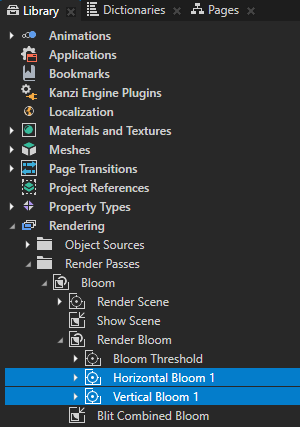
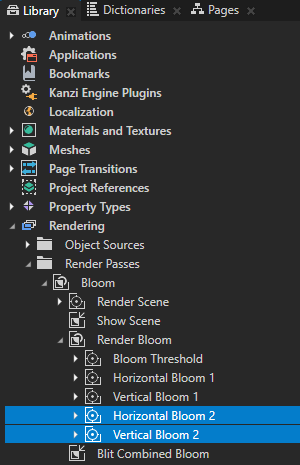
- Repeat the previous step twice but rename the render passes to:
- Horizontal Bloom 3 and Vertical Bloom 3
- Horizontal Bloom 4 and Vertical Bloom 4
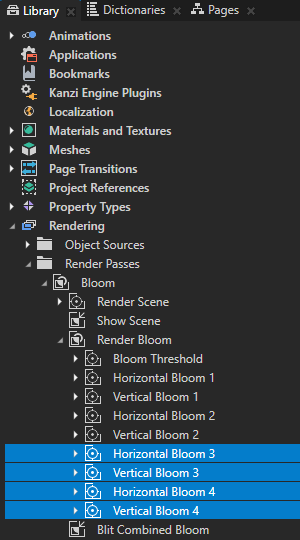
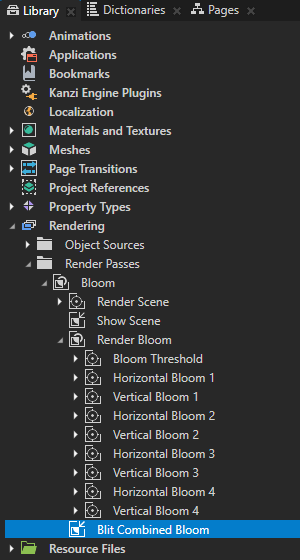
- In the Library select the Blit Combined Bloom render pass and in the Properties add and set:
- Texture1 to Vertical Bloom 2
- Texture2 to Vertical Bloom 3
- Texture3 to Vertical Bloom 4
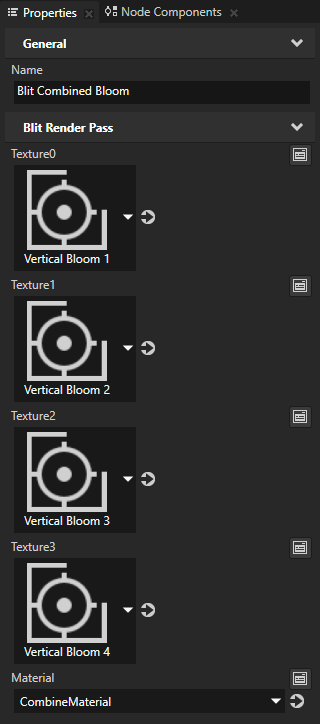
- In the Library hold down the Ctrl key, select the Horizontal Bloom 1 and Vertical Bloom 1 render passes, duplicate them, and rename the new render passes to Horizontal Bloom 2 and Vertical Bloom 2.
- Load the GaussianBloom09.kzmat material type from <KanziWorkspace>/Tutorials/Bloom/Assets.
The GaussianBloom09Material material provides a directional Gaussian blur effect using a kernel size of 9 pixels. To optimize performance you use smaller kernel sizes when possible.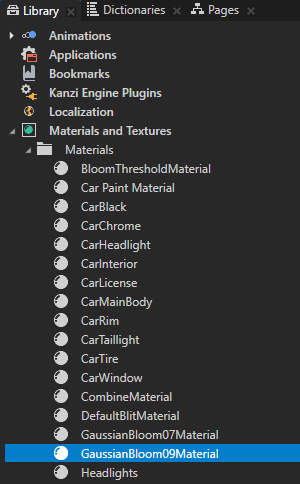
- Adjust the spread and intensity of the bloom effect:
- For each Composition Target Render Pass you created earlier in this procedure set the Resolution Divisor property to the value listed in this table:
This way you reduce the resolution of the composition target at every pass of the bloom effect, making the effect spread to a wider area.Composition Target Render Pass Resolution Divisor Horizontal Bloom 2 4 Vertical Bloom 2 4 Horizontal Bloom 3 8 Vertical Bloom 3 8 Horizontal Bloom 4 16 Vertical Bloom 4 16 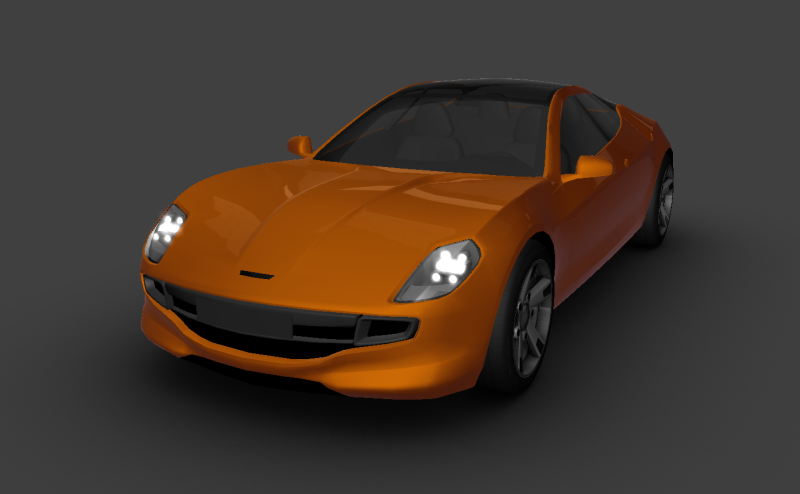
- For each Blit Render Pass you created earlier in this procedure set the properties to the values listed in this table:
Blit Render Pass Texture0 Material Blur Direction X Blur Direction Y Blur Radius Intensity Horizontal Bloom 2
> Blit Horizontal BloomVertical Bloom 1 GaussianBloom09Material 1 0 3,33 1,5 Vertical Bloom 2
> Blit Vertical BloomHorizontal Bloom 2 GaussianBloom09Material 0 0,5 3,33 1,5 Horizontal Bloom 3
> Blit Horizontal BloomVertical Bloom 2 GaussianBloom09Material 1 0 5 1,33 Vertical Bloom 3
> Blit Vertical BloomHorizontal Bloom 3 GaussianBloom09Material 0 0,5 5 1,33 Horizontal Bloom 4
> Blit Horizontal BloomVertical Bloom 3 GaussianBloom09Material 1 0 10 3 Vertical Bloom 4
> Blit Vertical BloomHorizontal Bloom 4 GaussianBloom09Material 0 0,5 10 3 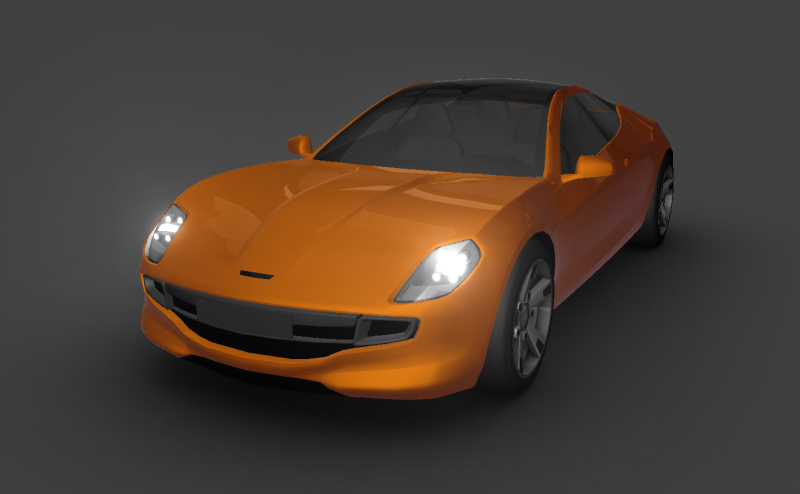
- In the Library select the Blit Combined Bloom render pass, and in the Properties add and set:
- Pass 1 Multiplier to 1
- Pass 2 Multiplier to 1,5
- Pass 3 Multiplier to 1,9
- Pass 4 Multiplier to 1,7
You can experiment with different multiplier values to see how each pass of the bloom effect affects the final outcome. 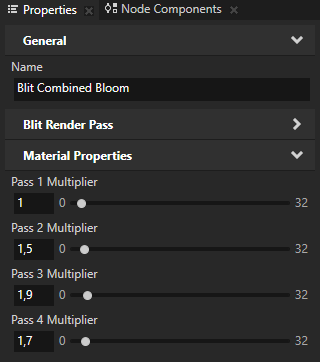
- For each Composition Target Render Pass you created earlier in this procedure set the Resolution Divisor property to the value listed in this table:
- In the Preview click and drag the car to see how the bloom effect looks when the car rotates.
< PREVIOUS STEP
What's next?
In this tutorial you learned how to use render passes and shaders to apply a bloom effect on 3D content.
Now you can:
- Learn how to use render passes to apply a directional Gaussian blur effect on 3D content. See Tutorial: Create a Gaussian blur effect.
- Learn how to apply a stencil to 3D content so that Kanzi renders only a selected area of the content. See Tutorial: Apply a stencil to 3D content.
- Learn how to rotate with a swiping gesture a 3D model in your Kanzi application. See Tutorial: Rotate a 3D model.
See also
To learn more about the render passes in Kanzi, see Rendering.
